
Topic: reducing stand cost without reducing quality · Based on: our own builds from 9 to 228 m²
There is a difference between a cheap stand and a well-judged one. A cheap stand looks cheap from six metres away. A well-judged stand spends money where visitors look and saves it everywhere else.
These are the decisions that actually move the number, in the order they are worth making.
1. Carpet instead of laminate — the biggest saving nobody resents
Flooring covers the largest single area of any stand and it is the surface people look at least. Laminate or a raised timber floor is expensive: material, a substructure to level it, labour to lay it and labour to lift it.
Good contract carpet in the right colour reads as deliberate, not as a compromise. It lays in a fraction of the time, it absorbs sound — which matters more than people expect in a hall full of noise — and it is kinder to stand on for three days.
When to spend on hard flooring anyway: a product demonstration with wheels or liquid, a machine that needs a level base, or a lounge where the floor is genuinely part of the design language. Otherwise, carpet.
2. Design it to be used more than once
This is the saving that compounds. A stand engineered for reuse costs more the first time and dramatically less every time after, because the second show is graphics and transport rather than graphics and fabrication.
The engineering that makes it work: panel sizes that fit a standard truck and a standard doorway, mechanical fixings instead of glue, a frame that bolts rather than screws into itself, and graphics carried on separate panels so the structure never has to change when the message does.
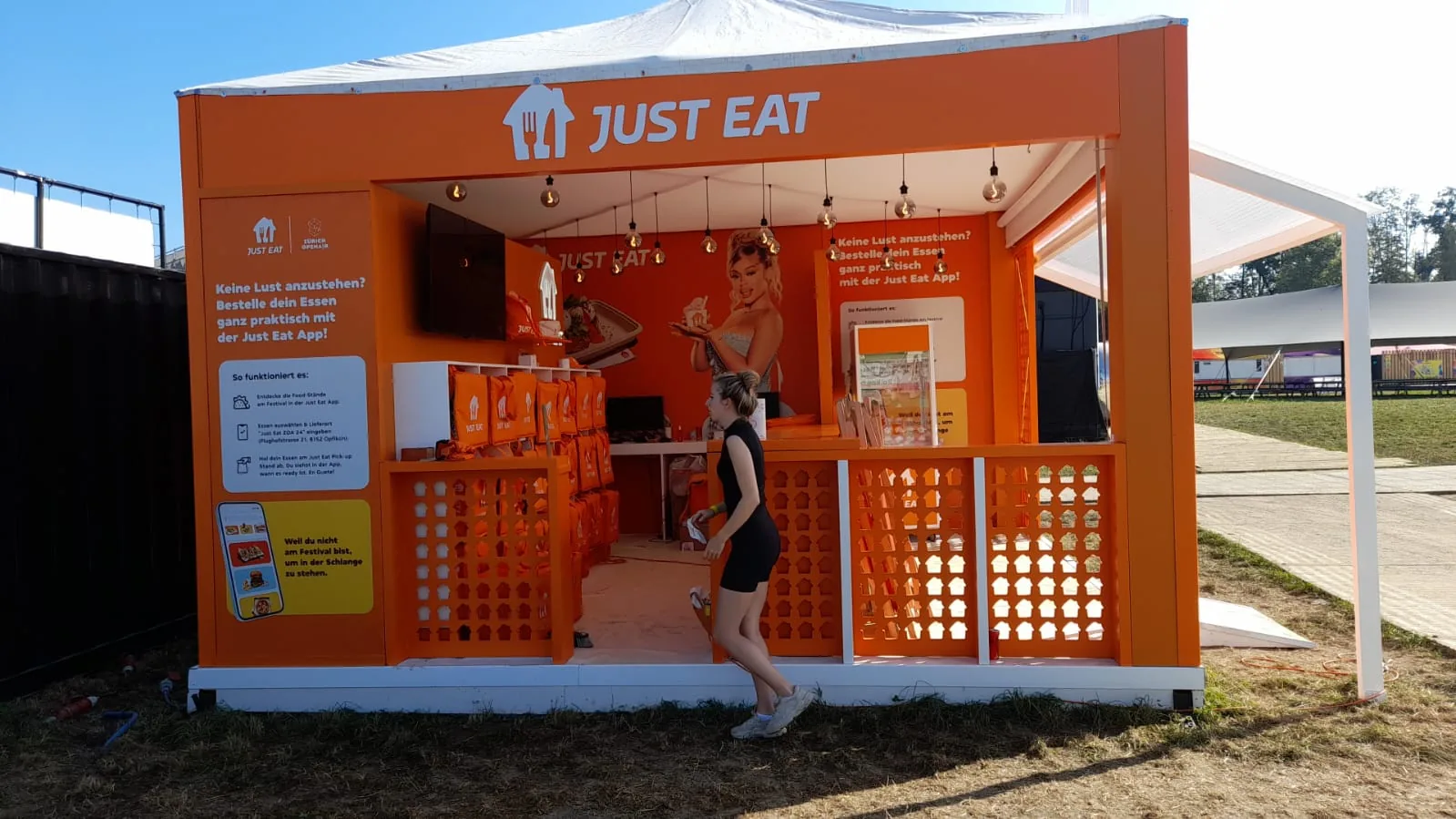
We built a festival pick-up station for Just Eat that ran two Swiss events in one summer on the same stand elements — Frauenfeld and Zurich Openair. Same structure, different show, no refabrication.
3. Change the graphics, not the walls
Most of what dates a stand is printed, not built. If the structure is neutral and the graphics carry the campaign, next year costs the price of printing.
The trap is designing a wall whose shape is the branding. A logo cut into the structure looks excellent for one year and becomes a demolition job the moment the brand shifts.
4. Hire the furniture, buy the things that get seen close up
Stools, standard tables, planters and basic seating are cheaper to hire than to own, store and freight. Nobody photographs a hire stool.
What is worth owning: the counter, the display units and anything a visitor stands next to and touches. Those carry the brand at conversation distance, and hire furniture never quite fits the design.
5. Let the lighting do the work
Lighting is the cheapest way to make a stand look expensive. A modest structure that is lit properly reads better than an elaborate one lit flatly by the hall.
Spend on: a lit fascia or halo so the stand reads from across the aisle, and a warm pool of light over any seating. Save on: decorative fittings that light nothing.
6. Be honest about the number of sides
A stand in a row needs one strong face. An island open on four sides needs four, and it needs storage designed into the middle because there is no back wall. Choosing a row or corner position over an island is a design decision with a large cost consequence, and it is worth making deliberately at the booking stage rather than discovering later.
7. Build near where the show is
Freight is a real line in every quotation and it scales with distance and volume. A stand built 20 minutes from the hall and one shipped across a continent are different prices for the same drawing.
Our workshop is in Corsico, twenty minutes from Fiera Milano Rho, with a second production site in Casablanca. That proximity is also why a change agreed on Tuesday can be cut Wednesday and fitted Thursday.
What we would never cut
Some savings cost more than they save.
- Structural quality and safety. Non-negotiable, and the venue will not negotiate either.
- The electrical connection. Under-ordering to save a little is how a stand trips on the morning of day one. Calculate it properly and order the right size.
- Installation time. A crew rushed on the last night produces the snags visitors notice first.
- Print quality on anything at eye level. A visibly pixelated panel undoes everything else on the stand.
- Storage between shows, if the stand is reusable. Storing it badly turns an asset into scrap.
The sustainable option is usually the cheap one, eventually
Reusable structure, replaceable graphics and hired furniture are the same list whether you arrive at it from cost or from carbon. Organisers are increasingly asking for it either way — see our note on Better Stands compliant construction.
A stand that is thrown away after one show was paid for twice: once to build and once to dispose of.
How to use this in a brief
Give your contractor a budget figure and tell them which of the above you are willing to trade. A designer who knows the constraint designs something buildable once. A designer who is guessing designs twice, and you pay for the round trip in time you do not have.
What to send with a quotation request sets out the six things that let us price a stand properly.
Related: Modular and reusable stands · Documented projects · What we deliver
Part of the exhibitor guide series. Start with the technical manual checklist — eleven things with deadlines attached.