
Event: any trade fair · Topic: stand electrical supply · Who needs this: anyone ordering power from an organiser
Every organiser asks you for one number: the size of the electrical connection your stand needs, in kilowatts. Order too little and something trips on the morning of day one. Order too much and you pay for capacity you never draw. Neither is expensive to avoid — the calculation takes ten minutes.
The calculation, in three steps
1. Add up the wattage of everything that draws power
Every appliance has a rating plate. It is usually on the back or underneath, and the figure you want is marked in watts — something like P = 227 W. Add them all together.
Rough guide figures, for planning before you have the real plates in front of you:
| Appliance | Typical draw |
|---|---|
| Coffee machine | 1,500 W = 1.5 kW |
| Cooking ring or hob | 1,500 W = 1.5 kW |
| Kettle | 1,000 W = 1 kW |
| Stove | 3,000 W = 3 kW |
| Dishwasher | 2,300 W = 2.3 kW |
| Refrigerator | 800 W = 0.8 kW |
| Microwave | 800 W = 0.8 kW |
| Vacuum cleaner | 2,000 W = 2 kW |
| LED spot, typical stand fitting | 200–230 W each |
These are planning figures only. The plate on your actual appliance wins every time.
2. Add ten per cent
Reserve capacity. It covers the gap between a rating plate and real-world draw, and it covers the thing somebody plugs in on day two that nobody mentioned in the plan.
3. Round up to the connection the venue sells
Venues supply in steps, not to the watt. You will be choosing from something like 3 kW, 4–6 kW, 10 kW, 16 kW and upward.
A worked example
A 36 m² stand with a small hospitality point:
| 4 LED spots at 227 W | 908 W |
| Coffee machine | 1,500 W |
| Refrigerator | 800 W |
| Subtotal | 3,208 W |
| Reserve at 10% | 321 W |
| Total requirement | 3,529 W = 3.53 kW |
3.53 kW does not fit a 3 kW connection. Order the 4–6 kW.
What you do not count
Screens, laptops, tablets, phone chargers, presentation kit and voice assistants all draw so little that including them distorts the calculation. Leave them out. A television is not a heater; a laptop is not a kettle.
The things people forget to count, on the other hand: LED walls, fridges under the counter, water boilers, coffee grinders, product demonstration units, and anything with a motor or an element in it. Motors and heating elements are where the load actually lives.
Single phase or three phase
Below roughly 3.6 kW you are in single-phase territory. Above it, most venues will put you on three phase, and anything with a large motor — a compressor, a lift, a big LED wall processor — may require three phase regardless of total load. If you are running a machine on the stand, ask the manufacturer for the phase requirement before you order the connection, not after.
Twenty-four hour supply is a separate order
The standard connection is switched off overnight with the hall. If you have a fridge with product in it, an aquarium, a server, or anything that must not power down, you need a 24-hour supply and it is ordered separately. This catches people out every single show. A fridge full of sample product on a standard supply is a fridge full of warm product on day two.
Order early — the deadline is real and it is expensive
Every venue has a cut-off after which electrical orders cost more, and a later one after which they cannot be delivered at all.
Messe Frankfurt, to take a well-documented example, asks for electrical orders no later than 22 days before the event opens, applies a 25% express surcharge to anything confirmed or changed after that, and states it cannot supply connections ordered within five days of the show. Other venues differ in the detail but not in the principle. (Messe Frankfurt)
This is the single cheapest saving available to an exhibitor: do the calculation once, early, and order on time.
A checklist you can work through
- Walk the stand plan and list every item that plugs in
- Read the rating plate on each one — not the guide table
- Add the wattages
- Add 10% reserve
- Round up to the next connection the venue sells
- Decide separately whether anything needs 24-hour supply
- Check whether any machine needs three phase
- Order before the venue’s deadline, not before the show
How we handle it
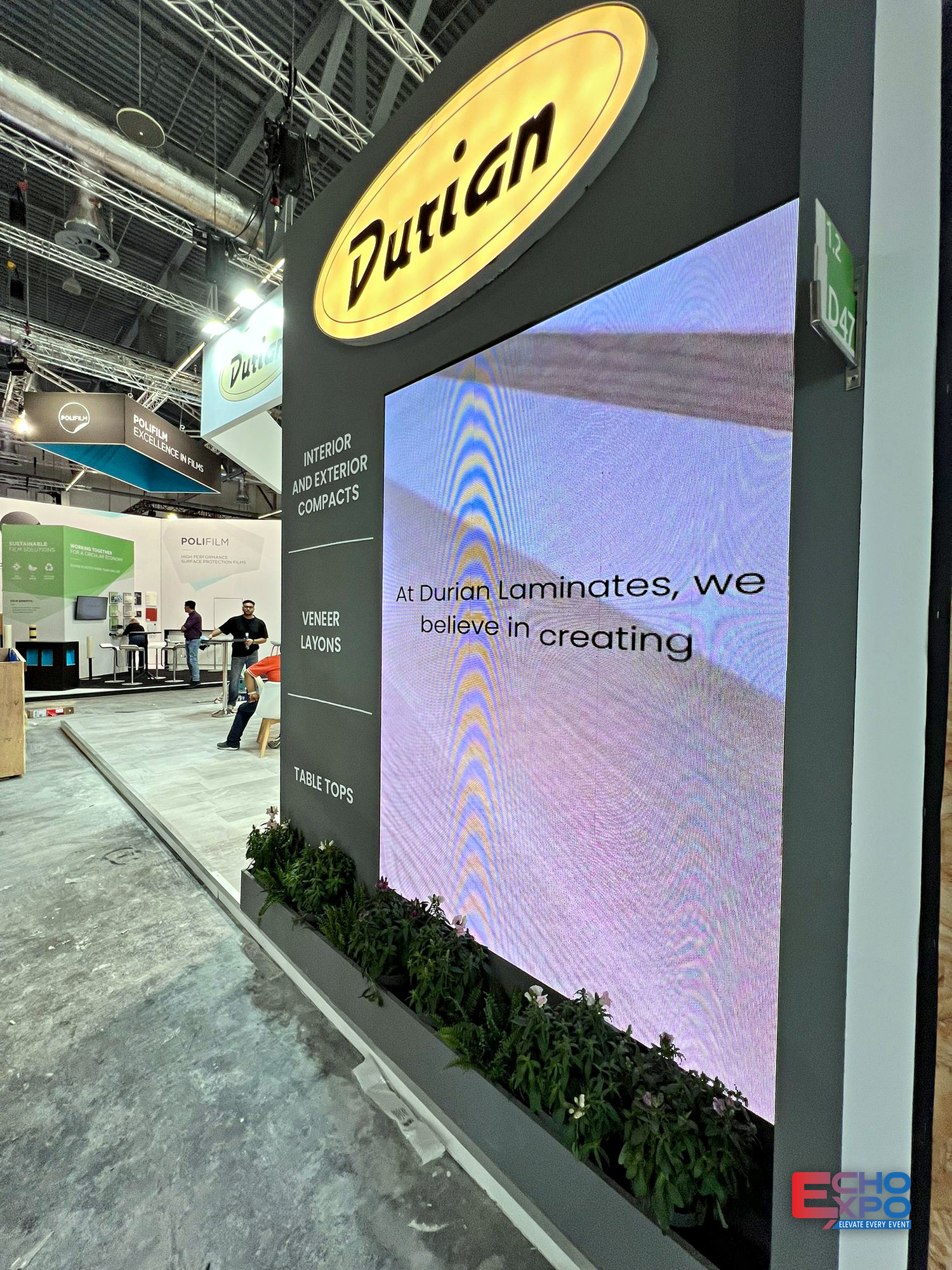
On every stand we build, the electrical load is calculated at the design stage and the connection is ordered as part of the venue paperwork — alongside rigging approval, floor loading and waste separation. It is not a thing the client is left to work out. On a 76.5 m² build at interzum Cologne with a 1.5 × 2 m LED wall in the lounge face, the load calculation shaped where the technical rack sat before a single panel was cut.
If you would rather it was simply handled, send us the stand details and it will be.
Related: Freight, customs and venue compliance · Where to save money on a stand · How we build
Part of the exhibitor guide series. Start with the technical manual checklist — eleven things with deadlines attached.