
Topic: the ATA carnet in Morocco and customs for exhibitors · Who needs this: any foreign company exhibiting at OFEC Casablanca, GITEX Africa, SIAM or another Moroccan show
If you exhibit in Morocco from abroad, everything you bring crosses Moroccan customs. That means your products, your demo equipment and, if you ship it, your stand. Goods that will leave again after the show have two legal routes: an ATA carnet in Morocco or the country’s own temporary admission regime. A third option removes most of the paperwork. In short, do not import the stand at all.
This guide explains all three in plain terms, so you can plan with your freight forwarder and your stand builder before the deadlines arrive.
The short answer
- Morocco accepts the ATA carnet. It has applied the ATA system since 1998, and exhibitors use carnets for Morocco mainly for trade fairs and exhibitions.
- Without a carnet, a customs broker can place your goods under Moroccan admission temporaire, a regime that suspends duties and taxes on goods imported to be shown at fairs and exhibitions.
- Either way, the goods must leave Morocco again within the authorised period. Items you sell, give away or use up at the show are a separate question for your broker.
- A stand built in Morocco never enters the customs file. Only your products and equipment travel.
What an ATA carnet is, and how it works for Morocco
An ATA carnet is an international customs document, often called a passport for goods. It lets you take goods into a country temporarily without paying import duties and taxes. However, you must take them out again. The International Chamber of Commerce’s World Chambers Federation runs the system, and each country has a national guaranteeing association that backs the carnets used there.
In Morocco, that association is the Chambre de Commerce, d’Industrie et de Services Casablanca-Settat (CCISCS), which the ICC lists as the ATA guarantor for the country. However, as a foreign exhibitor you normally obtain your carnet in your home country, from your own chamber of commerce, and present it at the Moroccan border.
Three practical points help:
- Validity: under the ATA convention a carnet is valid for up to one year from issue, so a single carnet can cover a show and its return journey.
- The goods list: every item needs a description, quantity, weight, value and, where it has one, a serial number. Customs check the list against the goods on the way in and on the way out.
- Language: Moroccan customs work in French, so a goods list written in French and English avoids questions at the border.
Morocco’s own temporary admission regime
If you do not use an ATA carnet in Morocco, your customs broker can declare the goods under admission temporaire. This is one of Morocco’s economic customs regimes. It suspends duties and taxes on goods you import to show the public at fairs and exhibitions, provided you re-export them within the authorised period. Customs usually require a guarantee while the goods are in the country.
For a one-off show, many exhibitors find a carnet simpler. Moreover, you prepare it at home and use the same document for the return. For larger or repeated programmes, a broker-managed temporary admission can make more sense. So ask your forwarder which route they handle best at the port or airport you will use.
What should travel under an ATA carnet in Morocco, and what should not
| Item | Best route |
|---|---|
| Products and samples on display | ATA carnet or temporary admission, then re-export |
| Demo machines, screens, IT equipment | ATA carnet or temporary admission, then re-export |
| Stand structure: walls, floor, counters, graphics, lighting | Build locally in Morocco, so nothing to import or re-export |
| Furniture | Rent locally |
| Brochures, giveaways, food and drink for tasting | These are consumed or given away, so they cannot simply be re-exported. Ask your broker how they will be declared |
Why a stand built in Casablanca simplifies the customs file
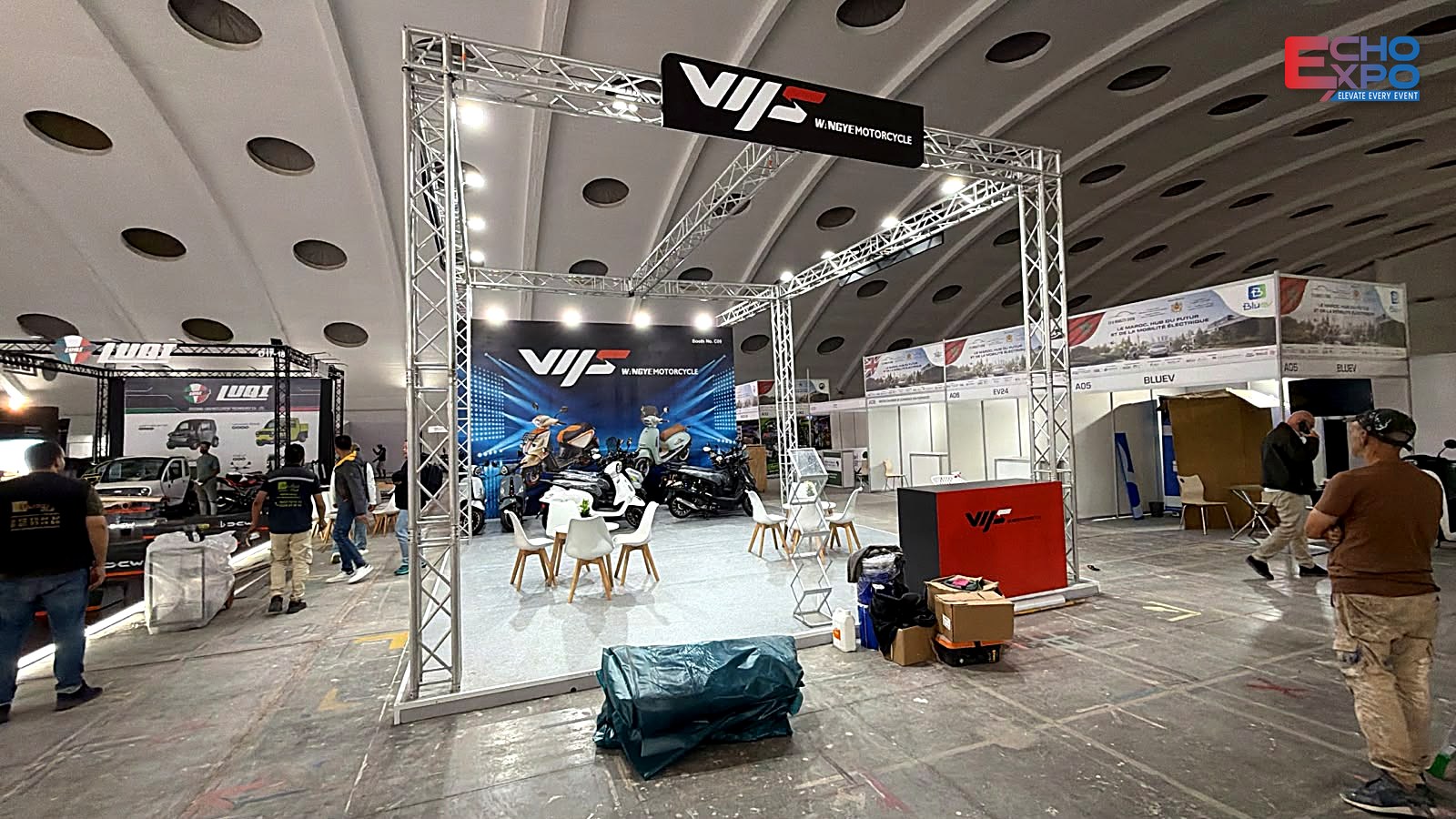
A shipped stand is the bulkiest, heaviest and most detailed part of any customs list. In practice, it means hundreds of panels, frames, lights and printed graphics, and customs count every one in and out again. In contrast, a stand fabricated in Morocco never appears on the list at all.
Echo Expo builds from our own workshop in Casablanca. For example, we built the 792 m² China pavilion at SIEMA Food Expo 2026 entirely in Casablanca for Chinese exhibitors, with 67 stands up in two days, so only their products needed an ATA carnet or temporary admission. Likewise, the three stands we built for EVS Morocco 2026 went up in a single build day.
There is a second advantage at the end of the show. At the Casablanca fairground, organisers often allow only one evening for removal. A local builder dismantles and takes the stand back to the workshop, whereas with a shipped stand you must crate every part, count it against the customs list and move it to the port before customs can discharge your carnet or guarantee.
A timeline for foreign exhibitors
- Four to six months out: book your space and request the exhibitor manual from the organiser.
- Three to four months out: choose your stand builder and decide which goods will travel. Appoint a freight forwarder and customs broker.
- Two to three months out: apply for your ATA carnet for Morocco at home, or agree the temporary admission plan with your broker. Prepare the goods list with values and serial numbers.
- Ten weeks out: approve the stand design and send the drawings to the organiser.
- Four weeks out: ship your products, allowing time for port or airport clearance.
- After the show: re-export the goods within the authorised period and make sure customs stamp out your carnet, so the issuer releases the guarantee.
Frequently asked questions
Does Morocco accept ATA carnets?
Yes. Morocco has applied the ATA carnet system since 1998, and exhibitors use carnets for Morocco mainly for goods shown at trade fairs and exhibitions.
Who issues ATA carnets in Morocco?
The national guaranteeing association is the Chambre de Commerce, d’Industrie et de Services Casablanca-Settat (CCISCS). Foreign exhibitors usually obtain their carnet from the chamber of commerce in their own country.
How long is an ATA carnet valid?
Under the ATA convention, a carnet is valid for up to one year from the date of issue. The goods must leave Morocco before the carnet expires.
Can I use temporary admission instead of an ATA carnet in Morocco?
Yes. A customs broker can declare your goods under Moroccan admission temporaire. It suspends duties and taxes on goods shown at fairs and exhibitions, as long as you re-export them within the authorised period.
Do I need to import my exhibition stand into Morocco?
No. If your stand is built by a local stand builder, such as our workshop in Casablanca, the structure never crosses the border. Only your products and equipment need a carnet or temporary admission.
What about brochures and giveaways?
Items you hand out, sell or consume at the show cannot be re-exported, so they cannot simply stay under a carnet or temporary admission. Ask your customs broker how they will be declared before you ship them.
This guide is general information, not customs advice. Rules and practice change. Therefore, always confirm the details with your carnet issuer or a licensed customs broker in Morocco.
Planning a stand in Morocco?
See our guide to the OFEC Casablanca fairground, the Morocco trade show calendar 2027 and our exhibition stands in Morocco page, read it in French on standiste à Casablanca, or send us your show and stand number.
Sources: ICC, ATA usage in Morocco · ICC, ATA carnet in your country · CCISCS, Carnet ATA · CCIS Rabat-Salé-Kénitra, régimes économiques en douane · Administration des Douanes et Impôts Indirects. Checked 31 October 2026.