
Home / EVS Morocco Stand Builder
EVS Morocco Stand Builder
Exhibition Stands Designed, Built and Installed for the Africa EV Mobility Expo at the Casablanca Fairground — 27–29 October 2026
The Africa EV Mobility Expo Morocco — listed on the show circuit as EVS Morocco — runs from 27 to 29 October 2026 at the Foire Internationale de Casablanca. It is an electric mobility show: passenger vehicles, two- and three-wheelers, batteries, charging hardware and the energy infrastructure behind all of it. Which makes it a show where the stand has to carry weight, deliver genuine power, and let a visitor walk onto it or climb aboard.
Echo Expo builds here from our own workshop in Casablanca. Components are cut, finished and numbered before they leave the workshop, then delivered to the hall in build sequence. For an exhibitor arriving from Europe or Asia that removes the two things that most often go wrong in Morocco — cross-border freight sitting on the critical path, and a subcontractor you have never met.
The Show, In Short
Event — Africa EV Mobility Expo Morocco 2026 (EVS Morocco)
Dates — 27–29 October 2026
Venue — Foire Internationale de Casablanca, Morocco
Organiser — MIE Group, with GEX Morocco and CCCME, the China Chamber of Commerce for Import and Export of Machinery and Electronic Products
Sectors — electric vehicles · energy and infrastructure · automotive aftermarket · parts and components · pavilions and associations · innovation and support
Stand types — space only and equipped shell scheme
These details were verified against the official event site on 4 September 2026 and against the 2026 exhibitor manual in October. The manual lists the venue as the Foire Internationale de Casablanca – AMDIE, with the show open from 10:00 to 18:00 on all three days. Dates and hall allocations move, so confirm the current position at evs-morocco.com before you commit to a build programme. The venue itself — hall dimensions, access and build conditions — is covered on our OFEC Casablanca stand builder page.
Our EVS Morocco 2026 Stands
As an EVS Morocco stand builder, we designed and built three stands for the 2026 edition under a signed contract, for three two-wheeler manufacturers. All three are space-only builds, 4 m high, and all three put the vehicles at the centre of the plot.
- WANGYE MOTORCYCLE — 54 m² (9 × 6 m), booth C09. A silver aluminium truss frame, 30 × 30 cm in section, carries three suspended brand fascias. Below it, three black panels with 3D cut-out letters and a wooden back wall dressed in tensioned fabric graphics frame the scooter line. Sixteen square LED panels light the display, and a lockable reception counter, 1.5 m long, anchors the front corner.
- HUAWIN — 36 m² (6 × 6 m), booths H07 and H08. A 4 m fabric graphic wall carries the brand story, while an L-shaped reception counter and five free-standing signage stands, one beside each motorcycle, give every model its own specification panel.
- ZHENGHAO — 36 m² (6 × 6 m), booths C17 and C18. A dark back wall, built at least 300 mm deep, uses green line graphics to frame the range, and the sport motorcycles sit across the open front of the stand.
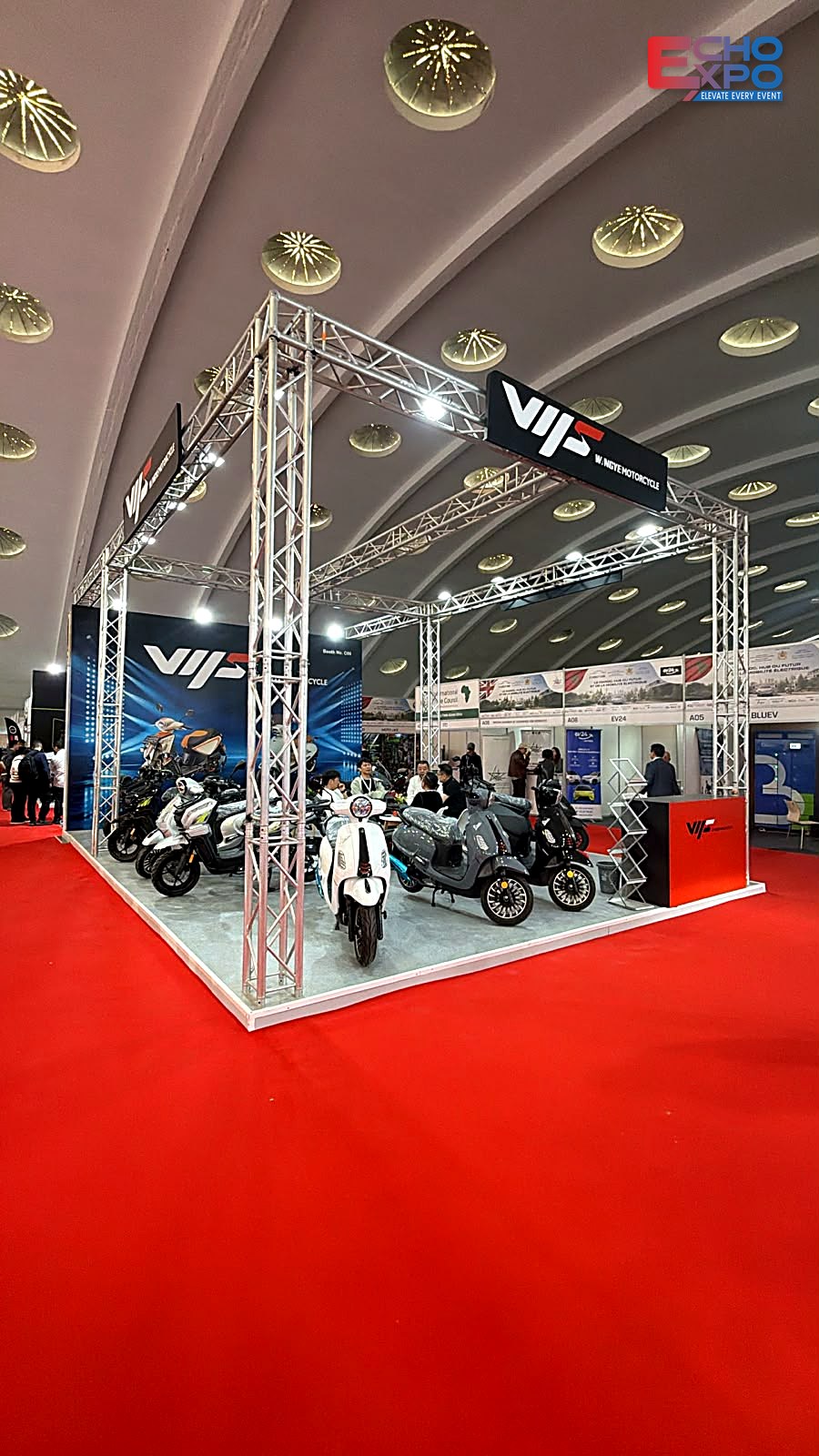
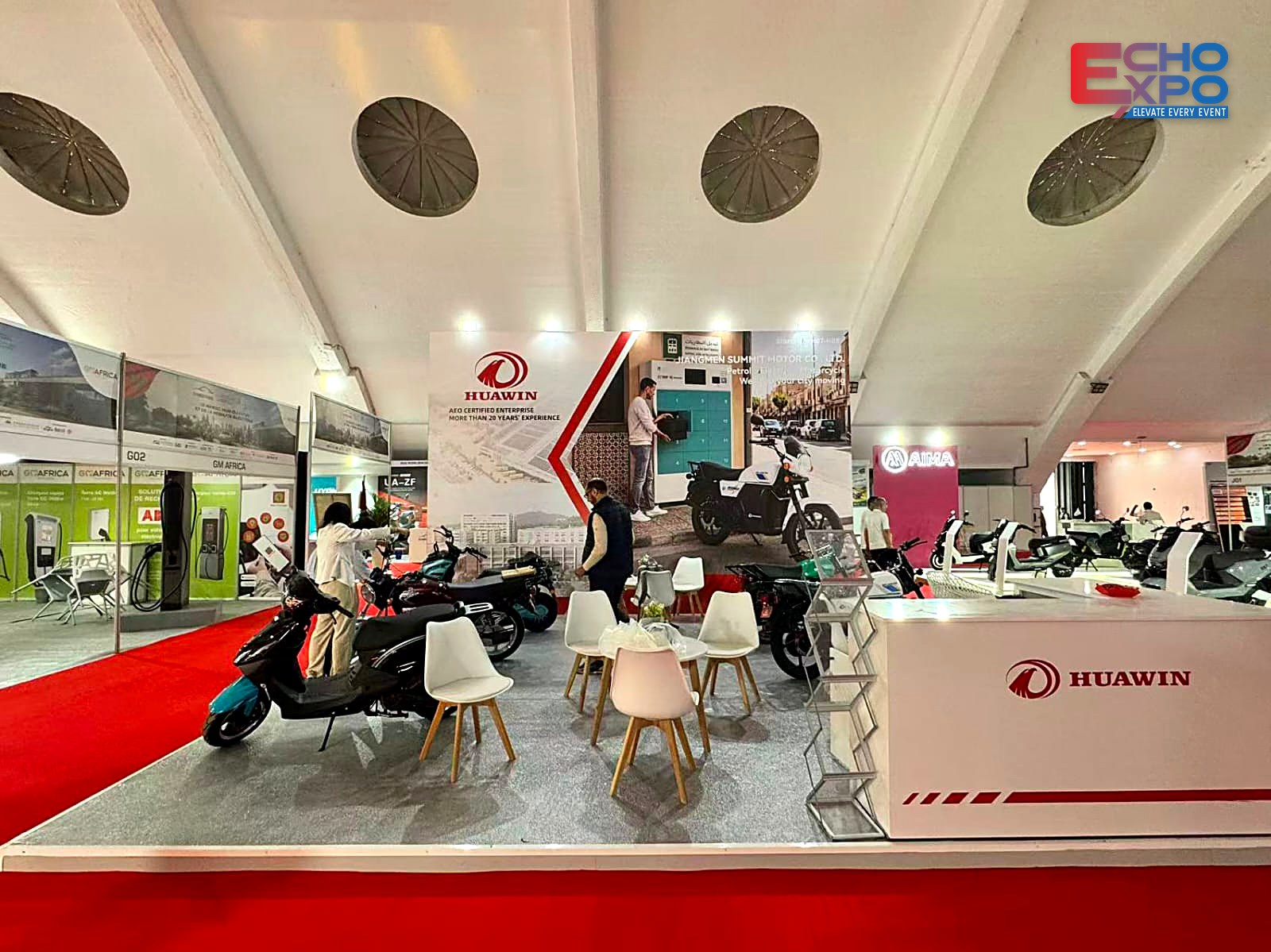
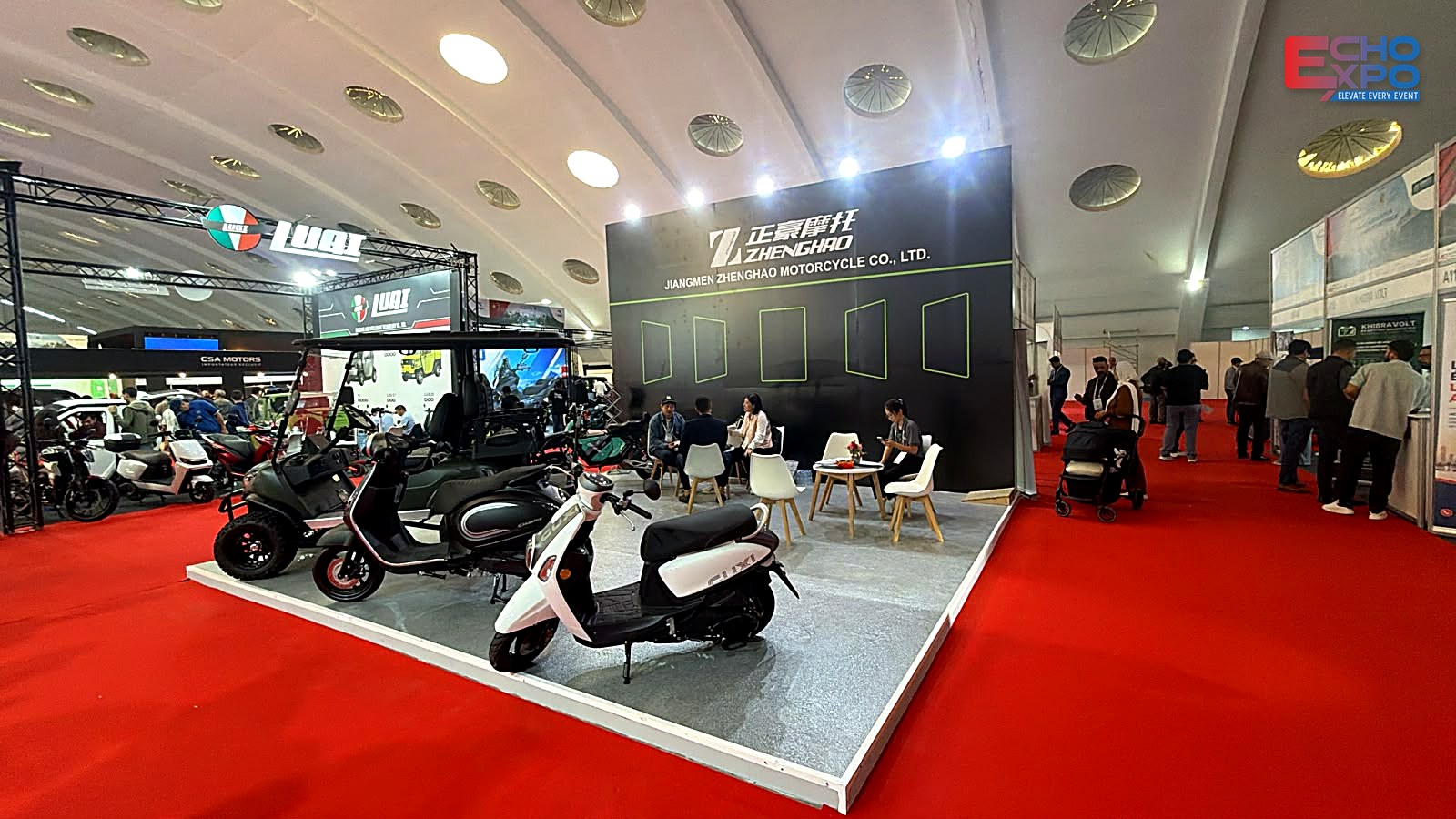
We built all three stands in a single day of the build-up, leaving the next day free for the exhibitors to arrange their vehicles. Read the full story, with build-up photos and the OFEC rules, in our EVS Mobility Expo Morocco 2026 case study.
Why An EV Stand Is Not A Standard Stand
Most exhibition stands hold literature, screens and people. An electric mobility stand holds a machine, and almost every design decision follows from that one fact.
- Floor loading and platforms. A raised deck carrying a car or a light commercial vehicle is a structural element, not a decorative one. It needs a load path, a ramp angle a vehicle can actually climb, and edges that will survive a tyre. We size the deck to the vehicle, not to the visual.
- Getting the vehicle in. Vehicles move in early, before aisle carpet is laid and before neighbouring stands close the route. That slot has to be booked with the organiser and designed into the build programme, or the stand gets finished around a gap the vehicle can no longer reach.
- Real power, not display power. Charging hardware, inverters and battery cabinets draw far more than a lighting rig. The supply is ordered by rating, single or three phase, and the distribution board is sized before the drawings are approved — not on the morning of build-up.
- Live charging demonstrations. Anything energised in front of the public needs isolation, protected cable routes and, at most venues, written sign-off. Ask early. It is a paperwork problem long before it is an engineering one.
- Batteries on display. Lithium cells and packs are frequently subject to declaration, storage and handling conditions. Raise them with the organiser at the same time as the stand drawings, not when the crate arrives.
- Two- and three-wheelers. Scooters, e-bikes and cargo trikes display best raised and turning. Plinths, turntables and secure anchoring are cheap to design in and expensive to add on site.
The Build Window Is The Real Constraint
For the 2026 edition, the exhibitor manual sets the timetable precisely, and it is tighter than it looks:
- Notice of intention — dimensioned front, side and rear elevations and the floor layout — to the organiser by 27 September
- Risk assessment for every space-only stand by 30 September; without it, the contractor is refused access
- Contractor registration form, signed, by 9 October, together with insurance certificates, a named list of every person on site and the plate of every vehicle
- Build-up: 24 and 25 October, 08:00 to 20:00, then 26 October, 08:00 to 13:00
- Stand occupied by 13:00 on 26 October, the day before the doors open at 10:00 on 27 October
- Dismantling starts right after closing on 29 October, from 18:00 to 22:00, and continues on 30 October from 08:00 to 22:00
In other words, the crew gets two and a half days on the floor, while the paperwork is due almost four weeks before the first truck arrives.
A stand cut and assembled on the hall floor will not make it. A stand that arrives prefabricated, numbered and sequenced will. That is how we work, and it is why the delivery order is part of the design rather than an afterthought. How we move stands across borders is covered on our exhibition freight and logistics page.

Group Pavilions And Country Participations
The show is organised in partnership with a Chinese chamber of commerce, and a substantial part of the floor is laid out as group participations rather than individual stands. That is a different job from building one exhibitor a stand. It is a production line: one visual system, dozens of booths, hundreds of printed panels, and every panel has to end up above the right door.
We built at that scale here in September 2026: 67 stands across 792 square metres for SIEMA FoodExpo, in four colour-coded pavilion groups, inside a two-day build window. If you are an organiser, an association or a national pavilion coordinator, that is the scale we plan for.
What We Handle As An EVS Morocco Stand Builder
- Stand design and 3D visualisation, from concept to approved technical drawings
- Vehicle platforms, ramps, turntables and display plinths
- Fabrication in our Casablanca workshop
- Graphics — fascia, banners, reception posters, wall panels and vehicle-bay backdrops
- Electrical distribution, lighting, AV and LED
- Furniture, meeting rooms and secure storage
- Organiser approvals — drawing submissions, height clearances, overhead and rigging permissions
- Installation and dismantling inside the official window
- On-site project management for the duration of the show
Rules Worth Knowing Before You Draw
Every venue has rules that quietly decide what a design can be, and at this fairground they are consistent from show to show. Self-build stands carry a height limit that cannot be exceeded without prior written approval. Drawings and 3D designs go to the organiser for approval weeks ahead of the show, and once approved, any change has to be notified immediately. Nothing may be hung in the fairground without permission, which normally carries a cost, and covering or spanning an aisle is usually refused outright.
Space-only stands include no services at all — carpet, furniture and electrics are ordered separately. We read the manual before we draw. Where a design touches a limit, the request goes in writing while a change is still cheap. Always check the exhibitor manual issued for your own edition; the numbers move.
What The 2026 Manual Adds For Vehicle Exhibitors
The 2026 EVS Morocco manual and the venue’s contractor form also add rules that matter more at an electric-mobility show than anywhere else:
- Batteries. Every battery fitted to a displayed vehicle must be removed, disconnected at all terminals or permanently isolated before the public is admitted, and it stays that way until the show closes
- Drip trays go under every vehicle, positioned so that doors, tail lifts and other protrusions stay inside the stand boundary
- No fuel handling. Filling or emptying a fuel tank inside the hall is prohibited at all times
- Floor loading. Anything above 1,000 kg per square metre needs prior approval, and spreader plates are mandatory
- Complex structures. Any element over 3.0 m high, any structure that needs bracing, a double deck or a platform above 600 mm needs the organiser’s prior approval, with a risk assessment, a method statement and structural calculations
- No wood-cutting on site. Circular saws, jigsaws, mitre saws and carpentry machinery are banned inside the fairground. Only assembly, fitting and light finishing are allowed, and hot work happens outside the halls under a permit
- PPE is enforced. Safety shoes, gloves, a high-visibility vest and a hard hat are the minimum, and only licensed operators may drive forklifts and lifts
Our three 2026 stands are all 4 m tall, so each one counts as a complex structure and follows that approval route. Because we prefabricate everything in our Casablanca workshop, however, the ban on cutting costs us nothing on site.
Getting There And Getting In
The fairground sits in central Casablanca, which is convenient for visitors and unforgiving for heavy vehicles. Mohammed V International Airport is roughly 30 kilometres south, and the Port of Casablanca is close enough that sea freight into the hall is realistic where the timing allows. Delivery slots, forklift and crane bookings and vehicle move-in are all controlled by the organiser, and are worth securing the moment your space is confirmed. More on how we work across the country is on our exhibition stands in Morocco page.
Frequently Asked Questions
Where Is The Africa EV Mobility Expo Morocco Held?
At the Foire Internationale de Casablanca, in Casablanca, Morocco — the same fairground that hosts the city’s other major trade shows. Our OFEC Casablanca venue page covers the hall, access and build conditions in detail.
When Is EVS Morocco 2026?
27 to 29 October 2026, verified against the official event site on 4 September 2026. Confirm the current dates at evs-morocco.com.
Can You Build A Stand That Displays A Vehicle?
Yes. In practice that means a platform designed for the vehicle’s weight, a ramp it can climb, a move-in slot booked with the organiser before the aisles are carpeted, and a route into the stand that stays open until the vehicle is in position.
Can We Run A Live Charging Demonstration On The Stand?
Usually, with the right supply and the organiser’s written approval. Tell us the rating and the phase you need at design stage — the electrical distribution is sized before the drawings are submitted, not after.
How Long Is The Build-Up?
For 2026, space-only contractors build on 24 and 25 October from 08:00 to 20:00, and on 26 October from 08:00 to 13:00. Either way, the answer is the same: prefabricate, because wood-cutting machines are not allowed in the hall.
Do You Build Group Pavilions And Country Participations?
Yes, and at scale. At SIEMA FoodExpo 2026 we delivered 67 stands across 792 square metres in four pavilion groups at this venue, as one coordinated build.
Which Stands Did You Build At EVS Morocco 2026?
Three space-only stands: WANGYE MOTORCYCLE at 54 m² on booth C09, HUAWIN at 36 m² on booths H07 and H08, and ZHENGHAO at 36 m² on booths C17 and C18, all 4 m high.
Do We Need A Moroccan Company To Exhibit?
No. You do not need a local entity or a local partner to have a stand built here. We handle the drawings, the approvals, the fabrication, the installation and the site management — and we are in the same building as the organiser when something needs resolving.
Planning A Stand At EVS Morocco
Appointing us as your EVS Morocco stand builder starts the same way every time. Send us your stand number and size, whether you are displaying vehicles, and what power you need. You will get a concept, a technical drawing set ready for organiser approval, and a build programme that fits inside the official window.