Echo Expo’s Tips for Exhibiting Across Borders: What to Expect in the EU
- Echo Expo Team
- June 15, 2025
Echo Expo’s Tips for Exhibiting Across Borders: What to Expect in the EU
Exhibiting across Europe offers incredible opportunities for global brands. However, pan-European exhibitions require careful cross-border planning. Each EU country has its own rules, cultural expectations, and technical standards. Therefore, understanding what to expect is essential for a smooth and successful exhibition experience.
First of all, multi-lingual graphics are a key requirement when exhibiting across Europe. While English is widely spoken, many European venues require local-language signage for safety, compliance, and visitor engagement. As a result, brands that invest in professionally translated graphics appear more credible and accessible to regional audiences.
Secondly, country-specific compliance plays a critical role in Exhibiting Europe. Fire safety rules, electrical certifications, height restrictions, and material approvals vary from country to country. For example, France demands extensive technical documentation, while Germany enforces strict fire-retardant standards. Without proper preparation, non-compliant stands may face delays or rejection. Therefore, working with an experienced exhibition partner is crucial.
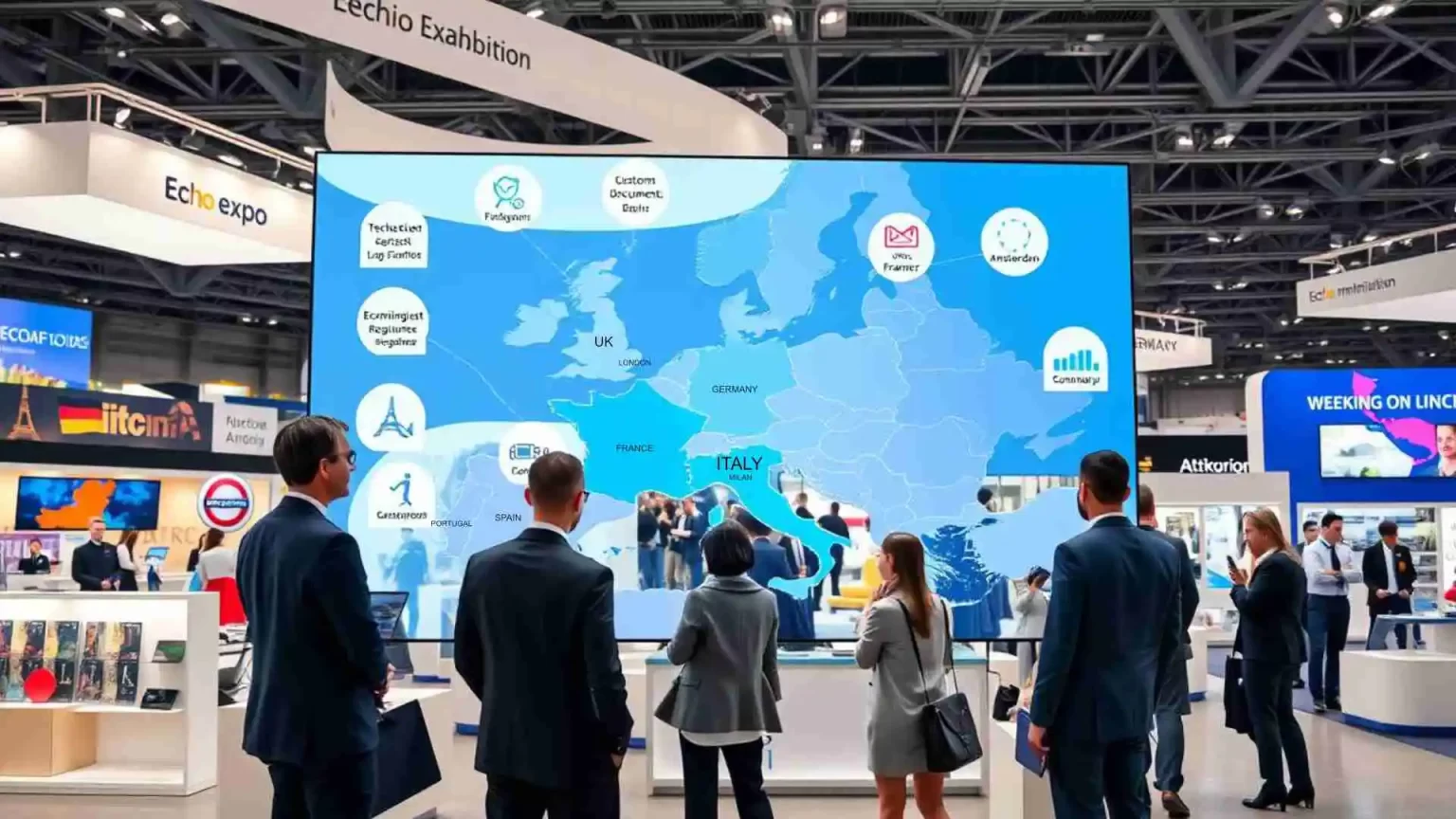
Exhibiting Europe require cross-border planning.
In addition, logistics coordination across show locations must be planned well in advance. Transporting stands between multiple European cities involves customs handling, timing restrictions, and venue-specific delivery schedules. Consequently, poor logistics planning can increase costs and disrupt build timelines for Exhibiting Europe.
Moreover, storage and reuse plans are becoming increasingly important for brands exhibiting at multiple EU trade shows. Instead of rebuilding from scratch, modular stand systems allow components to be stored, adapted, and reused across different exhibitions. This approach not only reduces waste but also improves cost efficiency and sustainability for Exhibiting Europe.
At Echo Expo, we manage every aspect of cross-border Exhibiting Europe from multilingual branding and legal compliance to logistics and long-term storage solutions. As a result, our clients can focus on networking, leads, and growth while we handle the complexity behind the scenes.
Exhibiting Europe doesn’t have to be complicated—with the right planning, it becomes a powerful gateway to European market success.
Echo Expo supports:
Multi-lingual graphics
Country-specific compliance
Logistics coordination across show locations
Storage and reuse plans
Venue rules we have met on real builds across Europe
General advice only goes so far. These are rules from organiser manuals we built under, with the project we built there. Treat them as examples: always check the current edition of your own show’s manual.
- Germany, Messe Frankfurt: the venue’s technical guidelines set heights, fire classes for materials and approval of special structures. JTAccord and TopToilet at ISH.
- Germany, Cologne: hanging structures need approved rigging points booked through the venue. Durian Laminates, 76.5 m² at interzum.
- France, Paris Nord Villepinte: the show’s architectural regulations set heights, setbacks from neighbours and drawing approval. HEXAGON, 36 m² at the World Nuclear Exhibition.
- Italy, Fiera Milano: every contractor works within the DUVRI safety framework, with contractor documents checked before the build. Olanska, 35.75 sqm at MCE.
- Switzerland, Palexpo Geneva: rigging points are set by Palexpo only, and multi-storey stands need engineering calculations two months ahead (General Regulations, 2024). Tata Coffee at World of Coffee.
- Spain, Fira Barcelona Gran Via: 3D and PDF approval about four weeks ahead, set build hours, no installation on opening day (NAEPEC 2023 manual). NAFFCO at NAEPEC.
- Sweden, Stockholmsmässan: stand height needed organiser approval before the build. MEDTRUM, 36 m² at EASD.
- Malta, SiGMA Europe: the show’s own exhibitor manual sets the build rules for its hall. UPGAMING, 70 m² stand.
A cross-border timeline that works
- Read the manual early. Note every deadline: drawings, rigging, power, insurance, contractor registration.
- Design to the strictest rule. If the stand will travel, design to the tightest height and fire rules among your shows.
- Book freight backwards from build day. Many venues do not receive or store goods, and shipments from outside the EU need customs paperwork. See exhibition freight and logistics.
- Translate graphics with the local team. Keep a master file per language so reprints are fast.
- Plan storage and reuse. See modular exhibition stands and reusable stands.
Frequently asked questions
Do stand rules change by country or by venue?
Both, but the venue and the organiser decide. Each show publishes a technical manual for its edition, and that document is binding. Two shows in the same country can have different height limits, deadlines and approval steps, so we always work from the current manual.
How early should stand drawings be submitted?
It depends on the show. In manuals we have worked with, drawings were due about four weeks ahead at Fira Barcelona Gran Via (NAEPEC 2023), while Palexpo in Geneva asks for multi-storey plans with engineering calculations two months ahead. We plan backwards from the earliest deadline.
Can one stand travel to several European shows?
Yes. A modular or reusable stand can be stored between shows and adapted to each space and manual. See our pages on modular exhibition stands and reusable stands.
OTHER ARTICLES
Recent POSTS